
Article By Shri Jaiprakash Rau (Senior Ex-IRS and Senior Faculty of UPSC)
Call or whatsapp at 9916082261 for UPSC Exams Training
1. Introduction
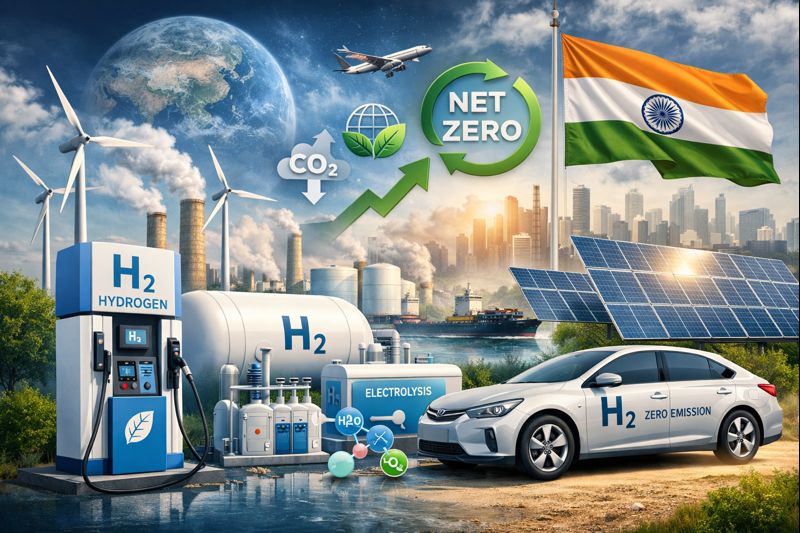
In the global pursuit of net-zero emissions and sustainable energy security, hydrogen has emerged as a strategic clean energy carrier, especially for decarbonising sectors where direct electrification is technically or economically unviable. Recognising this potential, countries including India have placed hydrogen at the centre of their long-term energy transition strategies.
2. What is Hydrogen Fuel?
- Hydrogen is the lightest and most abundant element in the universe.
- It is an energy carrier, not a primary energy source.
- When used in fuel cells or combustion, it produces water vapour as the only by-product.
- Reaction (Fuel Cell):
- Hydrogen + Oxygen → Electricity + Water + Heat
| Type of Hydrogen | Production Method | Emissions | Significance |
| Grey Hydrogen | Steam Methane Reforming (Natural Gas) | High CO₂ | Most widely used at present |
| Blue Hydrogen | Steam Methane Reforming with Carbon Capture and Storage (CCS) | Medium | Transitional fuel |
| Green Hydrogen | Electrolysis using renewable energy sources | Near-zero | Sustainable long-term option |
| Pink Hydrogen | Nuclear-powered electrolysis | Low | Emerging technology |
| Turquoise Hydrogen | Methane pyrolysis | Low | Experimental stage |
Green hydrogen is the focus of climate policy and India’s mission.
4. Why Hydrogen is Considered the Fuel of the Future
(a) Decarbonisation of Hard-to-Abate Sectors Steel (green steel via DRI) Fertilisers (green ammonia) Cement and petrochemicals Long-duration industrial heat
(b) Clean Transportation Fuel cell buses, trucks, trains Shipping (ammonia, methanol) Aviation (synthetic fuels)
(c) Renewable Energy Storage Seasonal storage for solar & wind Grid balancing and backup power
(d) Energy Security Reduces dependence on imported fossil fuels Enables domestic renewable utilisation
5. Advantages of Hydrogen Fuel Zero tailpipe emissions High energy content per unit mass Enables sector coupling (power–industry–transport) Supports deep decarbonisation beyond electricity
6. Challenges and Limitations
(a) Economic Challenges High cost of green hydrogen Expensive electrolysers Lack of economies of scale
(b) Technological Challenges Low overall energy efficiency Storage and transportation difficulties Hydrogen embrittlement of metals
(c) Infrastructure Constraints Lack of pipelines, refuelling stations Safety and handling concerns
(d) Water Requirement Electrolysis needs large quantities of water, relevant for water-stressed regions
7. India’s Initiatives (Highly Relevant) National Green Hydrogen Mission (2023) Target: 5 million tonnes per annum by 2030
Objectives:
- Decarbonise fertilisers & refineries
- Make India a global hydrogen hub
- Reduce fossil fuel imports
- Financial outlay: ₹19,744 crore
- India’s Strengths
- High solar and wind potential
- Growing electrolyser manufacturing base
- Large industrial hydrogen demand
8. Global Perspective
- EU: Hydrogen Strategy for climate neutrality
- Japan & South Korea: Hydrogen-based mobility
- International Hydrogen Trade emerging (Australia, Middle East)
9. Hydrogen vs Other Clean Energy Options
- Aspect: Hydrogen Electricity Biofuels
- Storage: Long-term Limited Moderate
- Industrial use: High Limited Limited
- Transport: Heavy & long-haulPassenger Blended
- Emissions: Zero at use Zero Low
Hydrogen complements, not replaces, electricity.
10. Way Forward
- Scale renewable capacity
- Reduce electrolyser costs through PLI schemes
- Develop hydrogen hubs and corridors
- Create global certification standards
- Ensure water-efficient electrolysis
- Promote R&D and skill development
11. Conclusion (Mains-Ready)
Hydrogen is not a silver bullet but a strategic pillar of the clean energy transition. While electricity will remain dominant, hydrogen will play a decisive role in achieving net-zero targets, particularly in hard-to-abate sectors. Its future depends on cost reduction, infrastructure development, and policy coherence.
UPSC RELEVANCE
GS Paper II
- Energy security
- Climate diplomacy
- International cooperation
GS Paper III
- Renewable energy
- Infrastructure
- Science & technology
- Environmental sustainability
Essay
- Energy transition
- Sustainable development
- Climate change mitigation
UPSC QUESTIONS
Prelims MCQs
Q 1. Consider the following statements about green hydrogen:
- It is produced using electrolysis powered by renewable energy.
2. It emits carbon dioxide during end use.
3. It can be used for seasonal energy storage.
Which of the above are correct?
a) 1 and 2
b) 1 and 3
c) 2 and 3
d) 1, 2 and 3
Answer: b) 1 and 3
Mains Questions
GS III (10/15 marks)
- “Hydrogen is not a universal substitute for fossil fuels but an essential complement to renewable electricity.” Discuss.
2. Examine the role of the National Green Hydrogen Mission in achieving India’s net-zero targets.
Essay Topic
Hydrogen Economy: Promise, Pragmatism and Policy