
Article By Shri JaiPrakash Rau (Senior Ex IRS and Senior UPSC Faculty)
Call and Whatsapp at 9916082261 for UPSC Preparation
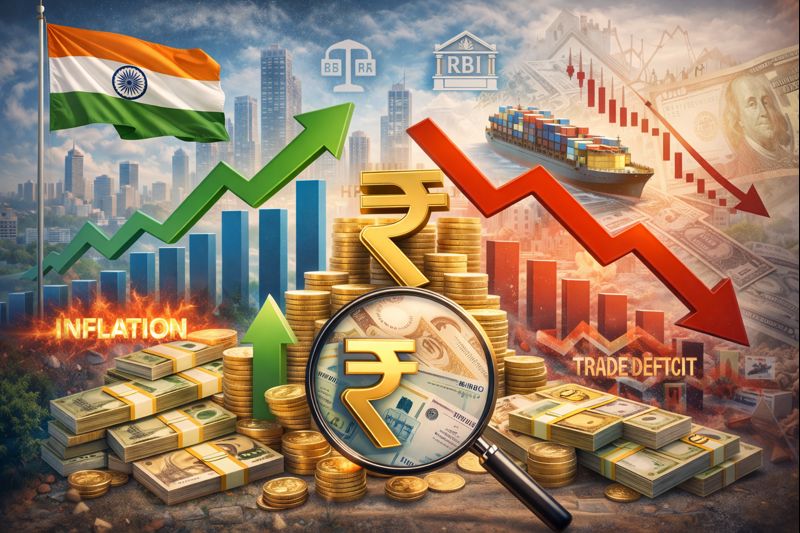
An Analytical explanation for UPSC aspirants
A growing economy does not automatically imply a strengthening currency. Exchange rates respond to relative macroeconomic fundamentals, global financial conditions, and capital flows, not only domestic GDP growth. The depreciation of the Indian Rupee (INR) amidst economic expansion can be explained through the following analytical lenses:
1. Growth vs Currency Strength: A Conceptual Distinction
- Economic growth reflects rising output, income, and consumption.
- Currency value reflects demand and supply of foreign exchange, influenced by trade, capital flows, inflation, and global risk sentiment.
- Fast-growing economies often import more capital goods, energy, and technology, increasing demand for foreign currency and putting pressure on the domestic currency.
- Hence, growth can coexist with currency depreciation.
2. Persistent Current Account Deficit (CAD)
India is a structural net importer, especially of:
- Crude oil
- Gold
- Capital-intensive machinery
- Higher growth → higher imports → widening CAD.
- A CAD implies greater demand for dollars than supply, weakening the rupee.
UPSC Insight: A growing developing economy often experiences “growth-led import surge”.
3. Capital Flows and Global Monetary Conditions
(a) Tight US Monetary Policy
- Higher US interest rates → better returns on dollar assets.
- Leads to:
- FII outflows
- Capital moving from emerging markets to the US
- This reduces dollar inflows into India, depreciating the rupee.
(b) Risk-Off Global Environment
- Global uncertainties (geopolitics, banking stress, trade wars) cause investors to prefer safe-haven currencies like USD.
- Emerging market currencies, including INR, face selling pressure.
4. Inflation Differential
- If India’s inflation remains higher than that of advanced economies, the rupee loses purchasing power over time.
- According to Purchasing Power Parity (PPP):
- Higher domestic inflation → currency depreciation in the long run.
- Even with growth, real exchange rate adjustment may require depreciation.
5. Strength of the US Dollar (Dollar Index Effect)
The rupee often falls not because it is weak, but because the US dollar is strong globally (Don’t fall for politically motivated comments)
When the Dollar Index rises:
- Most global currencies depreciate simultaneously.
- RBI focuses on preventing volatility, not defending a fixed level.
UPSC Tip: Distinguish bilateral depreciation from broad-based dollar appreciation.
6. RBI’s Managed Float Policy
- India follows a market-determined exchange rate with intervention.
- RBI allows gradual depreciation to:
- Maintain export competitiveness
- Avoid loss of foreign exchange reserves
- Absorb external shocks
- Defending a specific rupee level is neither feasible nor desirable.
7. Productive Use of Growth-Driven Capital
If growth is financed through external commercial borrowings (ECBs) or FDI:
- Future profit repatriation and debt servicing increase dollar demand.
- In the short run, capital inflows may be insufficient to offset trade deficits.
8. Structural Features of a Developing Economy
India is in a catch-up growth phase, characterized by:
- High investment needs
- Import-intensive infrastructure growth
- Gradual export diversification
- Currency depreciation acts as an adjustment mechanism, not necessarily a weakness.
9. Is Rupee Depreciation Always Negative? Not necessarily.
Positives:
- Improves export competitiveness
- Encourages import substitution
- Supports remittance inflows
Risks:
- Imported inflation
- Higher external debt servicing
- Pressure on fuel prices
- Hence, policy response matters more than the exchange rate level.
Conclusion (UPSC-Ready)
The depreciation of the rupee despite India’s economic growth reflects structural trade deficits, global monetary tightening, inflation differentials, and a strong US dollar, rather than domestic economic weakness. In a managed float regime, moderate depreciation serves as a shock absorber for a growing, import-dependent economy.
Keywords to Use in Answers
- Managed float exchange rate
- Current Account Deficit
- Capital flow volatility
- Inflation differential
- Dollar index
- Growth-led import surge
- what else can we add to enhance upsc aspirants’ knowledge
What else on this topic? As a seasoned faculty my perspective for UPSC
1. Real Effective Exchange Rate (REER) Perspective
(Very High Value for UPSC)
- The nominal INR may depreciate, but what matters for competitiveness is the REER (adjusted for inflation and weighted against trade partners).
- At several points, RBI has indicated INR overvaluation in REER terms, justifying nominal depreciation.
Value-add line:
“Nominal depreciation may represent correction toward REER equilibrium rather than currency weakness.”
2. Twin Deficits Hypothesis (CAD + Fiscal Deficit)
- High fiscal deficit → higher domestic demand → import surge → widening CAD.
- Fiscal expansion without commensurate productivity gains can weaken the currency.
UPSC linkage:
- FRBM
- Crowding out
- Macroeconomic stability triangle (growth–inflation–external balance)
3. Terms of Trade Shock (Oil Price Channel)
- India is a price taker in crude oil markets. Rising oil prices worsen:
- Trade balance
- Inflation
- Rupee stability simultaneously
- Even with strong GDP growth, adverse ToT shocks can depreciate the currency.
4. J-Curve Effect (Short-run vs Long-run Trade Balance)
- Currency depreciation initially worsens CAD due to:
- Inelastic import demand
- Contractual trade rigidities
- Export gains appear with a lag.
Diagram-friendly concept for Mains answer.
5. Capital Flow Composition Matters (FDI vs FPI)
- FPI is volatile, driven by interest rate differentials.
- FDI is stable, driven by growth fundamentals.
- India’s growth is increasingly FDI-led, but short-term currency movements are FPI-driven.
Growth does not immunize against short-term exchange rate volatility.
6. External Debt Structure & Currency Mismatch
- Even with moderate external debt, unhedged ECBs and corporate borrowings increase vulnerability.
- Depreciation raises:
- Debt servicing costs
- Balance sheet stress
UPSC Angle: Financial stability + corporate sector risk.
7. Impossible Trinity (Mundell–Fleming Framework)
- India balances:
- Monetary policy autonomy ✔
- Capital mobility ✔
- Exchange rate stability ✖
- Hence, rupee flexibility is inevitable in a globally integrated economy.
Excellent conceptual hook for GS-III answers.
8. Balassa–Samuelson Effect (Advanced Concept)
- Faster productivity growth in tradables → wage rise → inflation in non-tradables.
- Leads to real exchange rate appreciation pressure, often corrected via nominal depreciation.
- Useful for high-quality analytical enrichment.
9. Geopolitical & Geo-economic Factors
- Global supply chain fragmentation
- Sanctions regime
- Red Sea / West Asia disruptions
- Energy insecurity
- These increase precautionary dollar demand, weakening emerging market currencies irrespective of domestic growth.
10. RBI’s Policy Trade-offs (Beyond Intervention)
- Inflation targeting limits aggressive FX intervention.
- Excess intervention → liquidity distortion → monetary tightening contradiction.
Shows policy coherence, not policy failure.
11. Case Comparison (Optional 1–2 Lines)
- Similar patterns observed in:
- Indonesia
- Brazil
- South Africa
- Growth with currency depreciation is a common emerging market phenomenon, not India-specific.
Additional Keywords & Phrases to Sprinkle
- REER overvaluation
- Twin deficit hypothesis
- Terms of trade shock
- J-curve effect
- Mundell–Fleming trilemma
- FPI volatility vs FDI stability
- External sector resilience
- Macro-financial stability
- Exchange rate as shock absorber
One-Line Examiner-Impact Conclusion
“In an open, capital-integrated economy like India, currency depreciation amid growth reflects macroeconomic adjustment, global monetary asymmetry, and structural import dependence rather than economic fragility.”
UPSC Prelims
Q. Consider the following statements regarding exchange rate movements in a growing economy:
1.High GDP growth does not necessarily lead to currency appreciation if capital outflows exceed inflows.
2.A widening current account deficit exerts downward pressure on the domestic currency.
3.Higher domestic inflation compared to trading partners can strengthen the currency in the long run.
Which of the statements given above is/are correct?
a) 1 and 2 only
b) 2 and 3 only
c) 1 only
d) 1, 2 and 3
Correct Answer: a) 1 and 2 only
Explanation (Brief):
Exchange rates are influenced by balance of payments, capital flows and inflation differentials. High inflation erodes competitiveness and weakens the currency rather than strengthening it.
Mains GS Question
- “Economic growth alone is insufficient to ensure currency stability.”
2. In the context of the recent depreciation of the Indian Rupee, examine the macroeconomic and global factors responsible for this phenomenon.