
Article is written by (Retd) Senior IRS Officer Dr. Jaiprakash Rau
Join Crash of Economics By Dr Jaiprakash Rau for UPSC
Call at 9916082261 for details
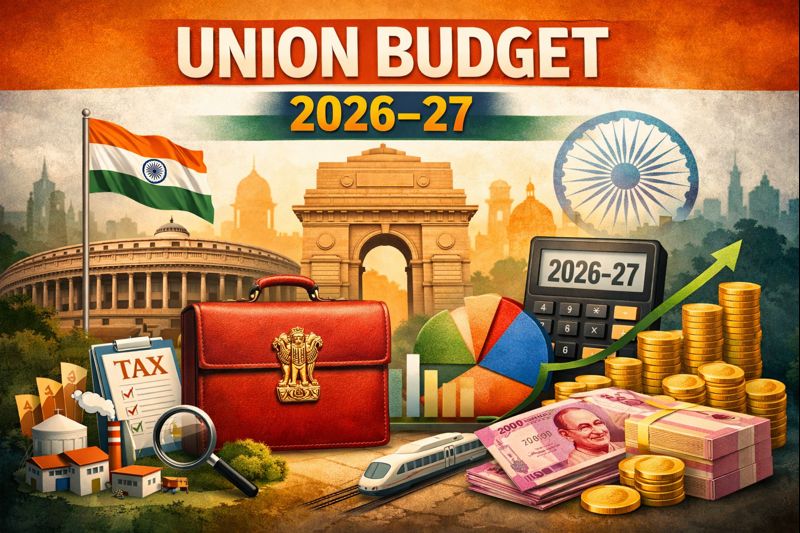
UNION BUDGET 2026–27
“RUPEE COMES FROM & RUPEE GOES TO” — COMPREHENSIVE ANALYTICAL NOTES
I. RECEIPTS SIDE: “RUPEE COMES FROM”
(Structure, Signals, and Systemic Risks)
1. Borrowings & Other Liabilities – 24 paise
Largest source of funds
What it shows
Government continues to rely heavily on debt-financed expenditure
Borrowings exceed any single tax source
Fiscal Context
Fiscal deficit targeted at 4.3% of GDP (2026–27)
Indicates calibrated consolidation, not abrupt austerity
Analytical Insight
India is following a growth-first fiscal strategy:
Borrow now → invest in infrastructure → expand GDP → improve future revenue
Sustainability depends on growth rate > interest rate (r < g condition)
UPSC-ready line
“India’s fiscal architecture reflects a deliberate tolerance for higher debt today in anticipation of growth-led revenue tomorrow.”
Risks
Rising interest payments
Reduced fiscal flexibility during shocks (oil, climate, geopolitics)
2. Income Tax – 21 paise
Second-largest contributor; exceeds corporate tax
Structural Shift
For the second consecutive year, personal income tax > corporate tax
What it indicates
Formalisation of economy:
PAN–Aadhaar–GST linkage
Digitisation and compliance
Expansion of salaried & professional class
Positive Signal
Broad-based revenue source
Less volatile than corporate profits
Concern
Over-reliance may:
Suppress consumption
Create middle-class tax fatigue
UPSC Insight
“India’s tax structure is gradually transitioning from enterprise-led to household-led fiscal capacity.”
3. Corporation Tax – 18 paise
Context
Still below pre-2019 levels in proportional terms
Reflects impact of corporate tax rationalisation
What it suggests
Profitability concentrated among large firms
MSME recovery remains uneven → K-shaped recovery
Exam Link
Effectiveness of supply-side reforms
Corporate tax buoyancy vs investment response
4. GST & Other Taxes – 15 paise
Role
Backbone of indirect taxation
Stable, consumption-linked revenue
What the number tells
Consumption growth is steady, not overheated
GST has matured but not become dominant
Federal Angle
Centre’s GST reliance vs States’ compensation concerns
Prelims Trap
GST is not the largest Union tax source → Income tax is
5. Non-Tax Revenue – 10 paise
Includes
RBI surplus transfer
PSU dividends
User charges
Analytical Caution
Largely non-recurring
Volatile and not structurally dependable
Governance Concern
Using one-off receipts for recurring expenditure risks fiscal opacity
6. Union Excise (6 paise) & Customs (4 paise)
Declining relevance due to
GST subsuming indirect taxes
Trade liberalisation
Strategic tariff adjustments for Make in India
Policy Insight
Reduced flexibility to absorb oil price shocks via excise tweaking
7. Big Picture: Receipts Side
Theme Insight
Debt Largest funding source
Taxes More compliant, more personal
Indirect taxes Stabilised, not dominant
Asset monetisation Weak
Mains-ready summary
“India’s fiscal consolidation remains revenue-supported but debt-driven, with improved compliance yet limited non-debt capital mobilisation.”
II. EXPENDITURE SIDE: “RUPEE GOES TO”
(Commitments, Constraints, and Choices)
1. States’ Share of Taxes – 22 paise
Largest expenditure item
Constitutional Basis
Article 270
Finance Commission devolution
What it reflects
Formal commitment to fiscal federalism
Reality Check
States still constrained by:
Centrally Sponsored Schemes
Conditional grants
Off-budget borrowings
UPSC Angle
Cooperative vs competitive federalism debate
2. Interest Payments – 20 paise
Second-largest expenditure
Nature
Non-discretionary
Past borrowing burden
Core Issue
Every rupee spent here:
Does not create assets
Shrinks developmental space
Striking Insight
“India borrows a quarter of every rupee and spends one-fifth merely to service past borrowings.”
3. Central Sector Schemes – 17 paise
Includes
Infrastructure
Digital public infrastructure
Railways, highways
Link with Capex
Aligns with ₹12.2 lakh crore capital expenditure target
Governance Trend
Increasing centralisation of development delivery
Trade-off
Efficiency vs state autonomy
4. Defence – 11 paise
Priority Area
National security
Strategic autonomy
Hidden Reality
Revenue expenditure dominates
Capital outlay often discussed separately
UPSC Note
True defence burden understated in pie charts
5. Centrally Sponsored Schemes – 8 paise
Examples
MGNREGA
PM-Kisan
Persistent Issue
Scheme proliferation
Outcome efficiency vs spending
Finance Commission Context
Long-standing recommendation for CSS rationalisation (Based on recommendations from the NITI Aayog sub-group of Chief Ministers, India’s Centrally Sponsored Schemes (CSS) were rationalized in 2016 to reduce 66 schemes into 28 umbrella schemes to enhance efficiency. These are divided into “Core of the Core,” “Core,” and “Optional” schemes with restructured funding, giving states more flexibility.)
6. Finance Commission & Other Transfers – 7 paise
Purpose
Grants-in-aid
Disaster management
Local bodies
Role
Corrects vertical & horizontal imbalances
7. Subsidies – 6 paise
Focus Areas
Food
Fertiliser
Fuel
Positive Trend
DBT improving targeting
Rationalisation visible
Constraint
Politically sticky expenditure
8. Pensions – 2 paise
Appears small but
Fixed and rigid
Long-term liabilities increasing
Emerging Risk
Old Pension Scheme pressures at state level
III. SYNTHESIS: WHAT THE TWO PIES TOGETHER REVEAL
1. Debt as Both Source and Sink
24% receipts from borrowing
20% spent on interest
Debt is simultaneously financing growth and constraining it
2. Fiscal Rigidity
States’ share (22%) + Interest (20%)
42% pre-committed
Limited room for new policy initiatives
3. Tax Structure Transformation
Personal income tax > corporate tax
Signals formalisation, but risks demand compression
4. Capex Push within Constraints
Central Sector Schemes + high capex target
Growth depends on execution efficiency
IV. PRELIMS QUICK FACTS
Largest receipt → Borrowings
Largest expenditure → States’ share
Interest payments > Defence
GST not largest tax source
Subsidies only 6%
V. MAINS-WORTHY CONCLUSION
“The Union Budget 2026–27 reflects a cautious but confident fiscal statecraft — prioritising growth through debt-funded capital expenditure, supported by rising tax compliance, yet constrained by rigid commitments and rising interest obligations. The challenge ahead lies not in mobilising resources, but in converting fiscal effort into durable fiscal freedom.”