

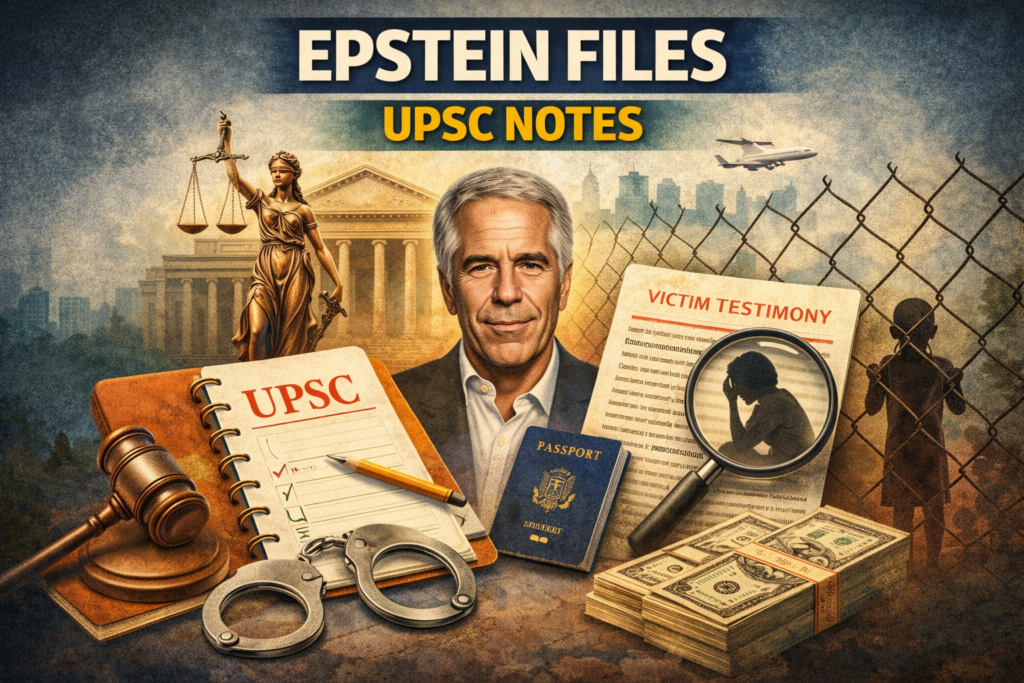
The Epstein Files have emerged as a key topic in global discussions on justice, ethics, and accountability. These files, which include court documents, victim testimonies, and financial records, reveal the operations of Jeffrey Epstein’s transnational network and the challenges of prosecuting elite individuals. For UPSC aspirants, understanding the Epstein Files is crucial for topics like human trafficking, ethical governance, and rule of law, as it highlights issues of elite impunity, institutional accountability, and human rights violations. This article provides comprehensive UPSC notes, covering the legal, ethical and governance dimensions of the Epstein Files for both Prelims and Mains preparation.
What are the “Epstein Files”?
- The Epstein Files refer to court documents, investigative records, flight logs, testimonies, and sealed materials linked to Jeffrey Epstein, a US financier accused of sex trafficking, sexual abuse of minors and operating an international exploitation network.
- Many documents were sealed for years and later released following court orders and public pressure, revealing names of influential individuals.
Who was Jeffrey Epstein?
- American billionaire financier with connections to politicians, royalty, celebrities, academics and business leaders.
- Arrested in 2019 on federal charges of sex trafficking of minors.
- Died in jail (2019) under controversial circumstances; officially ruled a suicide.
- Earlier conviction in 2008 (Florida) involved a controversial plea deal, raising questions on elite influence over justice.
Key Revelations from Epstein Files
- Flight logs (“Lolita Express”) showing travel of high-profile individuals to Epstein’s private island.
- Witness testimonies alleging abuse facilitated by Epstein’s network.
- Financial records indicating money flows linked to hush payments and settlements.
- Failure of institutions (law enforcement, prosecutors) to act decisively earlier.
⚠️ Important: Presence of names does not automatically imply guilt—UPSC answers must maintain legal caution.
Why are the Epstein Files Important?
1. Rule of Law & Accountability
- Highlights selective justice and unequal application of law.
- Raises concerns about elite impunity in democratic systems.
2. Human Rights Perspective
- Serious violations of child rights, women’s rights and human dignity.
- Underscores gaps in victim protection and rehabilitation.
3. Institutional Ethics (GS-IV)
- Ethical failure of:
- Prosecutors
- Law enforcement agencies
- Media silence in early years
International Implications
- Cross-border nature of crimes → need for international legal cooperation.
- Questions about financial secrecy jurisdictions, offshore accounts and weak regulation.
- Relevance to global movements against sexual exploitation and trafficking.
Relevance for India (UPSC Angle)
- India is a signatory to UN Convention against Transnational Organized Crime.
- Reinforces need for:
- Strong implementation of POCSO Act
- Independent investigative agencies
- Protection for whistle-blowers
- Lessons for judicial transparency and speedy trials.
Ethical Dimensions (GS-IV)
- Power vs Responsibility
- Silence of bystanders
- Media ethics and investigative journalism
- Victim-centric justice vs reputation of the powerful
Way Forward (Mains Enrichment)
- Greater judicial transparency in high-profile cases.
- Stronger victim-witness protection mechanisms.
- Global cooperation on financial crimes & trafficking.
- Ethical training and accountability of public officials.
Keywords for Answer Writing
- Elite capture of institutions
- Selective justice
- Transparency & accountability
- Human dignity
- Rule of Law
- Power asymmetry
Possible UPSC Questions
Prelims:
- Epstein Files are associated with which of the following issues? (Human trafficking / Judicial transparency / Financial secrecy)
Mains (GS-II / GS-IV):
- “The Epstein case exposes systemic failures in upholding the rule of law.” Discuss.
- Examine the ethical challenges posed by elite influence over justice delivery systems.