
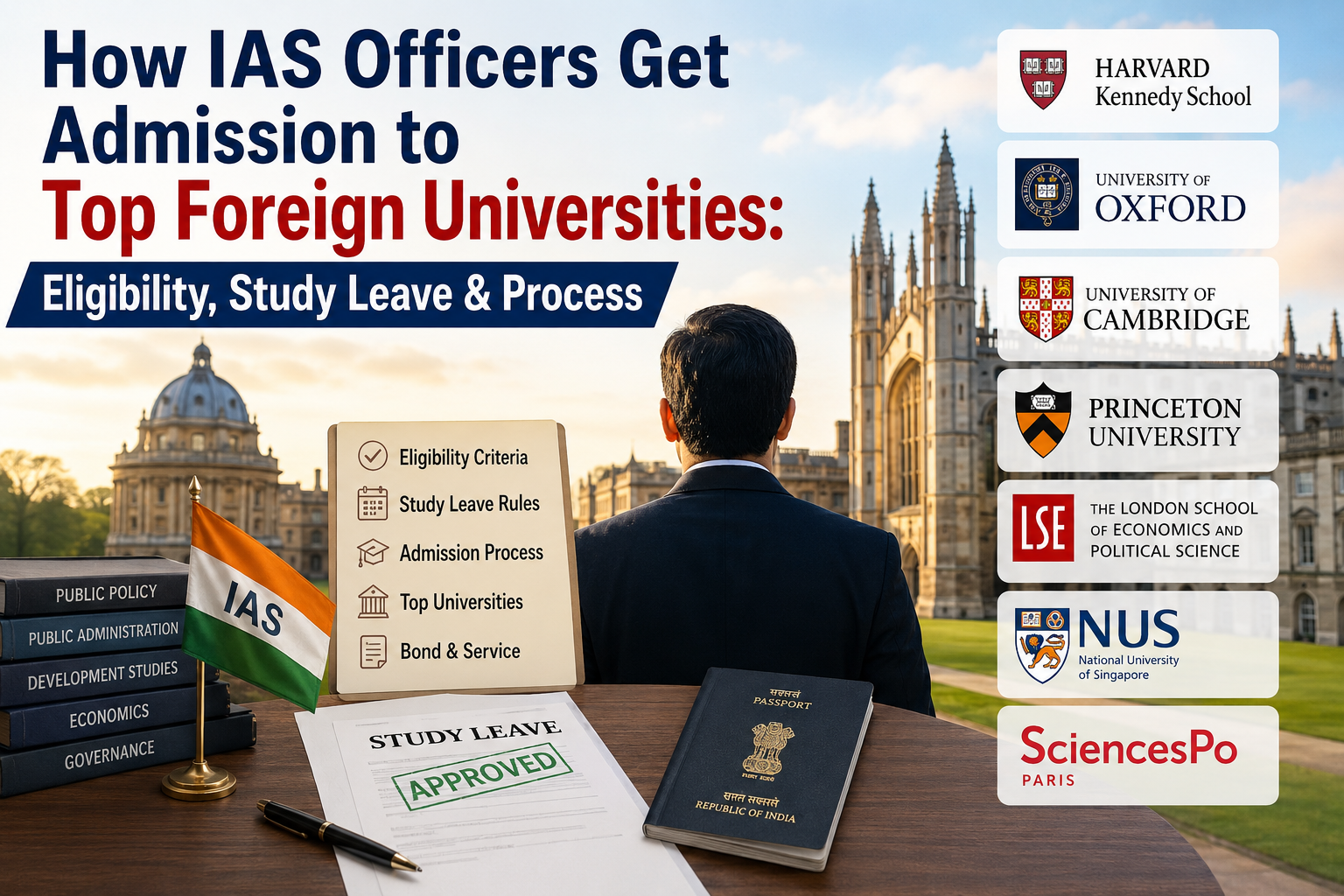
Many IAS officers pursue higher education at leading foreign universities such as Harvard Kennedy School, University of Oxford, University of Cambridge, Princeton University, London School of Economics and Political Science, National University of Singapore and Sciences Po through study leave granted by the Government of India.
1. Eligibility for Study Leave
Under the All India Services (Study Leave) Regulations, 1960 and the AIS (Leave) Rules, 1955, an IAS officer is generally eligible if:
- Has completed 9 years of service (6 years for certain North-East cadres in specified cases).
- The proposed course is relevant to public administration, governance, economics, public policy, law, management, technology, environment, or another area useful to government service.
- The government is satisfied that the course is in the public interest.
- The officer has a good service record and receives cadre clearance.
2. Duration of Study Leave
- Normally up to 24 months during the entire career.
- Usually granted in one spell for Master’s programmes.
- Additional short ex-India leave (such as for joining formalities) may be permitted under recent guidelines.
3. Admission Process
Admission is not arranged by the Government.
The IAS officer must independently:
- Choose the university.
- Take required examinations (if applicable), such as:
- GRE (if required)
- GMAT (for some management programmes)
- IELTS/TOEFL (if required)
- Submit:
- Academic transcripts
- Statement of Purpose (SOP)
- Resume
- Recommendation letters
- Work experience details
Only after obtaining admission does the officer seek government approval for study leave.
4. Government Approval
Approval generally requires:
- State Cadre recommendation
- Cadre Controlling Authority approval
- Approval from the Department of Personnel and Training (DoPT) for IAS officers studying abroad.
The government examines:
- Relevance of the programme
- Public interest
- Availability of officers in the cadre
- Administrative requirements
5. Salary During Study Leave
Depending on the applicable rules and approvals:
- Leave salary is admissible as per AIS rules.
- Officers may continue to receive certain benefits during approved study leave.
- Recent DoPT instructions clarify which authority bears the salary if the officer is on Central Deputation.
6. Bond Requirement
Before proceeding abroad, the officer signs a bond agreeing to:
- Return to government service after completing the course.
- Serve the Government of India/State Government for a specified period (commonly five years) after return.
- Refund the government expenditure if the bond conditions are violated.
7. Popular Courses Chosen by IAS Officers
- Master of Public Administration (MPA)
- Master in Public Policy (MPP)
- Public Administration
- Economics
- Public Finance
- Development Studies
- International Development
- Environmental Policy
- Public Health
- Data Science for Governance
- Artificial Intelligence and Public Policy
8. Universities Frequently Chosen
Some of the most common destinations include:
| University | Popular Programme |
|---|---|
| Harvard Kennedy School | MPA, Mid-Career MPA |
| University of Oxford | MPP, Public Policy |
| University of Cambridge | Public Policy |
| Princeton University | MPA |
| London School of Economics and Political Science | Public Administration |
| National University of Singapore | Lee Kuan Yew School MPA |
| Sciences Po | Public Affairs |
9. Recent Guidelines
The Government has strengthened oversight by requiring officers on study leave to:
- Adhere to the All India Services (Conduct) Rules, 1968 while abroad.
- Submit an undertaking to comply with conduct rules.
- Face disciplinary action for violations.
- Ensure that states provide details on the utilization and postings of officers returning from foreign study leave when recommending new proposals.
Summary
| Aspect | Requirement |
|---|---|
| Minimum service | Generally 9 years |
| Maximum study leave | 24 months during career |
| Government approval | Mandatory |
| Admission | Must be obtained independently |
| Bond | Mandatory |
| Salary | As per AIS Study Leave Rules |
| Return to service | Compulsory after completion |
For UPSC aspirants, understanding these provisions is useful for questions related to Civil Services reforms, capacity building, governance, public administration, and personnel management in the General Studies papers and interview.