

UPSC Current Affairs & GS Paper II and III | July 2026
Why is PMKSY in News?
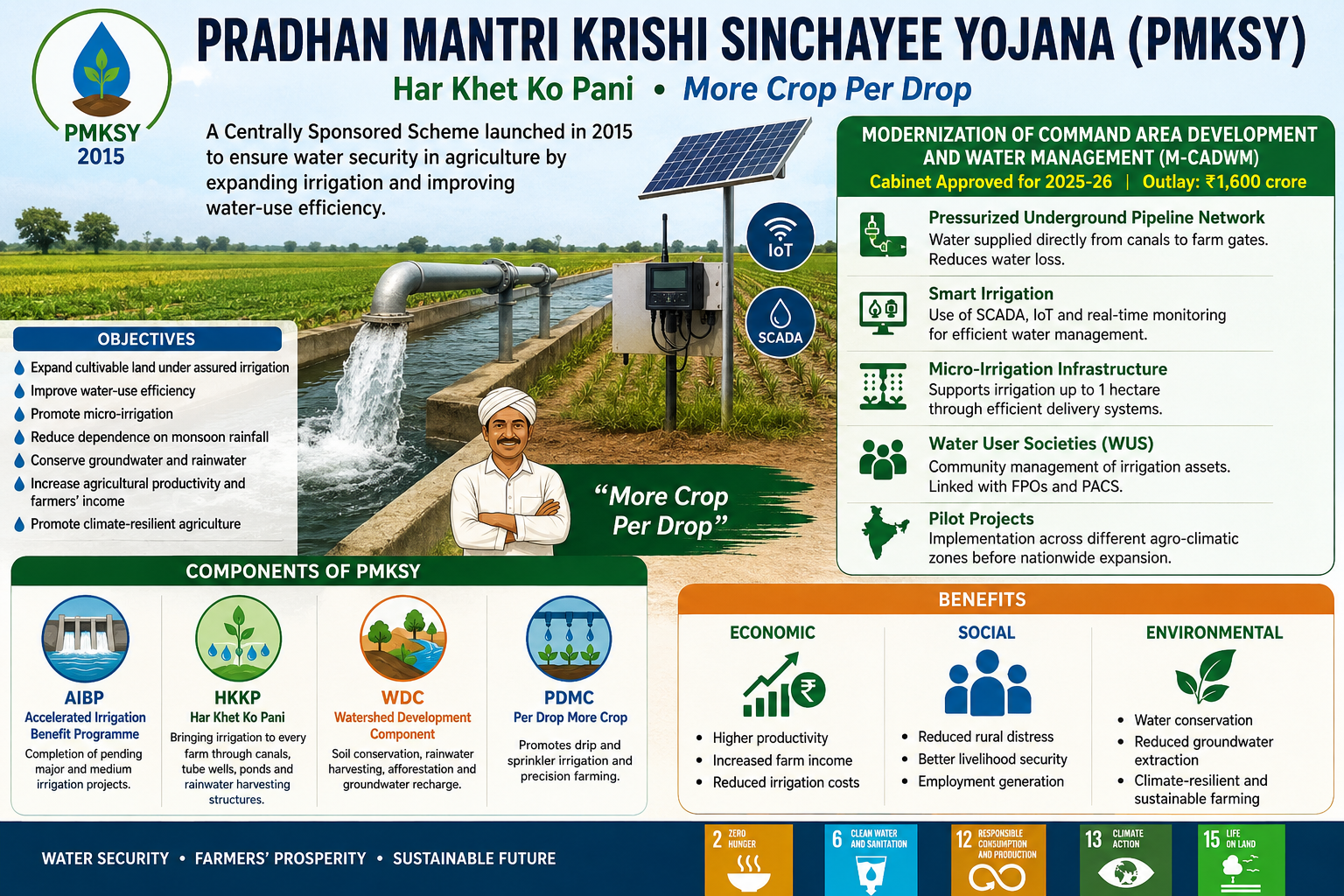
The Union Cabinet approved the Modernization of Command Area Development and Water Management (M-CADWM) as a sub-scheme of the Pradhan Mantri Krishi Sinchayee Yojana (PMKSY) for 2025–26.
The initiative focuses on modernizing irrigation infrastructure using advanced technologies such as SCADA (Supervisory Control and Data Acquisition) and the Internet of Things (IoT) to improve water-use efficiency and agricultural productivity. A National Plan is proposed from April 2026 based on the outcomes of pilot projects.
What is PMKSY?
Pradhan Mantri Krishi Sinchayee Yojana (PMKSY) was launched in 2015 as a Centrally Sponsored Scheme to ensure water security in agriculture by expanding irrigation facilities and improving water-use efficiency.
Motto
“Har Khet Ko Pani” (Water to Every Field)
Theme
“More Crop Per Drop”
Nodal Ministry
- Ministry of Jal Shakti
- Ministry of Agriculture & Farmers Welfare
- Ministry of Rural Development
It is an umbrella scheme that integrates irrigation, watershed development, and efficient water management.
Objectives of PMKSY
- Expand cultivable land under assured irrigation.
- Improve water-use efficiency.
- Promote micro-irrigation (drip and sprinkler systems).
- Reduce dependence on monsoon rainfall.
- Conserve groundwater and rainwater.
- Increase agricultural productivity and farmers’ income.
- Promote climate-resilient agriculture.
Components of PMKSY
1. Accelerated Irrigation Benefit Programme (AIBP)
- Completion of pending major and medium irrigation projects.
- Creation of irrigation potential.
2. Har Khet Ko Pani (HKKP)
- Bringing irrigation to every farm.
- Construction of canals, tube wells, ponds and rainwater harvesting structures.
3. Watershed Development Component (WDC)
- Soil conservation
- Rainwater harvesting
- Afforestation
- Groundwater recharge
4. Per Drop More Crop (PDMC)
- Promotes drip and sprinkler irrigation.
- Encourages precision farming.
- Now implemented separately under the Rashtriya Krishi Vikas Yojana (RKVY) framework while remaining aligned with PMKSY’s objectives.
Latest Update: Modernization of Command Area Development and Water Management (M-CADWM)
The Cabinet approved a new modernization initiative under PMKSY with an initial outlay of ₹1,600 crore.
Key Features
Pressurized Underground Pipeline Network
- Water supplied directly from canals to farm gates.
- Reduced water loss during transportation.
Smart Irrigation
Use of:
- SCADA
- IoT-based monitoring
- Real-time water accounting
Micro-Irrigation Infrastructure
Supports irrigation up to 1 hectare through efficient delivery systems.
Water User Societies (WUS)
- Community management of irrigation assets.
- Linked with Farmer Producer Organisations (FPOs) and Primary Agricultural Credit Societies (PACS).
Pilot Projects
Projects will begin across different agro-climatic zones before nationwide expansion.
Importance for Indian Agriculture
India faces several irrigation challenges:
- Around half of cultivated land remains rain-fed.
- Groundwater depletion is increasing.
- Climate change has made rainfall more erratic.
- Water-use efficiency is relatively low.
PMKSY addresses these challenges through:
- Scientific irrigation
- Water conservation
- Improved irrigation infrastructure
- Better crop planning
- Sustainable groundwater management
Benefits of PMKSY
Economic
- Higher crop productivity
- Increased farm income
- Reduced irrigation costs
Social
- Reduced rural distress
- Better livelihood security
- Employment generation
Environmental
- Water conservation
- Reduced groundwater extraction
- Climate-resilient agriculture
- Sustainable farming practices
Challenges
- Slow completion of irrigation projects.
- Inter-state water disputes.
- Uneven implementation across states.
- High initial cost of micro-irrigation.
- Poor maintenance of irrigation infrastructure.
- Low awareness among farmers.
Way Forward
- Expand micro-irrigation coverage.
- Strengthen Water User Associations.
- Promote crop diversification.
- Use AI, GIS and remote sensing for irrigation planning.
- Encourage community-based water budgeting.
- Converge PMKSY with schemes like MGNREGA, Jal Jeevan Mission and Atal Bhujal Yojana.
UPSC Relevance
Prelims
Know:
- Launch year (2015)
- Motto: “Har Khet Ko Pani”
- Theme: “More Crop Per Drop”
- Components of PMKSY
- Implementing ministries
- Recent M-CADWM initiative
GS Paper II
- Government policies
- Agricultural governance
- Centre-State coordination
GS Paper III
- Agriculture
- Irrigation
- Water conservation
- Climate-resilient farming
- Sustainable development
Essay
Useful for topics on:
- Water security
- Sustainable agriculture
- Climate change
- Inclusive rural development
Value Addition
Constitutional Provisions
- Article 48A: Protection and improvement of the environment.
- Article 51A(g): Fundamental duty to protect natural resources.
SDGs Linked
- SDG 2: Zero Hunger
- SDG 6: Clean Water and Sanitation
- SDG 12: Responsible Consumption and Production
- SDG 13: Climate Action
- SDG 15: Life on Land
Previous UPSC Questions
- Explain the importance of micro-irrigation in Indian agriculture.
- Discuss the role of watershed development in sustainable agriculture.
- “Water conservation is the key to doubling farmers’ income.” Examine.
UPSC Mains Practice Question (15 Marks)
“Pradhan Mantri Krishi Sinchayee Yojana has shifted India’s irrigation policy from expansion of irrigation to efficient management of water resources.” Discuss in the light of recent reforms under the Modernization of Command Area Development and Water Management (M-CADWM). (250 words)
Quick Revision Box
| Particular | Details |
|---|---|
| Launch | 2015 |
| Motto | Har Khet Ko Pani |
| Theme | More Crop Per Drop |
| Type | Centrally Sponsored Scheme |
| Major Ministry | Ministry of Jal Shakti |
| Key Components | AIBP, HKKP, WDC, PDMC |
| Latest Update | M-CADWM approved for 2025–26 |
| Technologies | SCADA, IoT, pressurized piped irrigation |
| Focus | Water-use efficiency, smart irrigation, climate-resilient agriculture |
Conclusion: PMKSY has evolved from an irrigation expansion programme into a comprehensive water management mission. The recent M-CADWM initiative marks a shift toward technology-enabled irrigation, community participation, and efficient water use, making the scheme highly relevant for India’s goals of sustainable agriculture, enhanced farmer incomes, and climate resilience.