

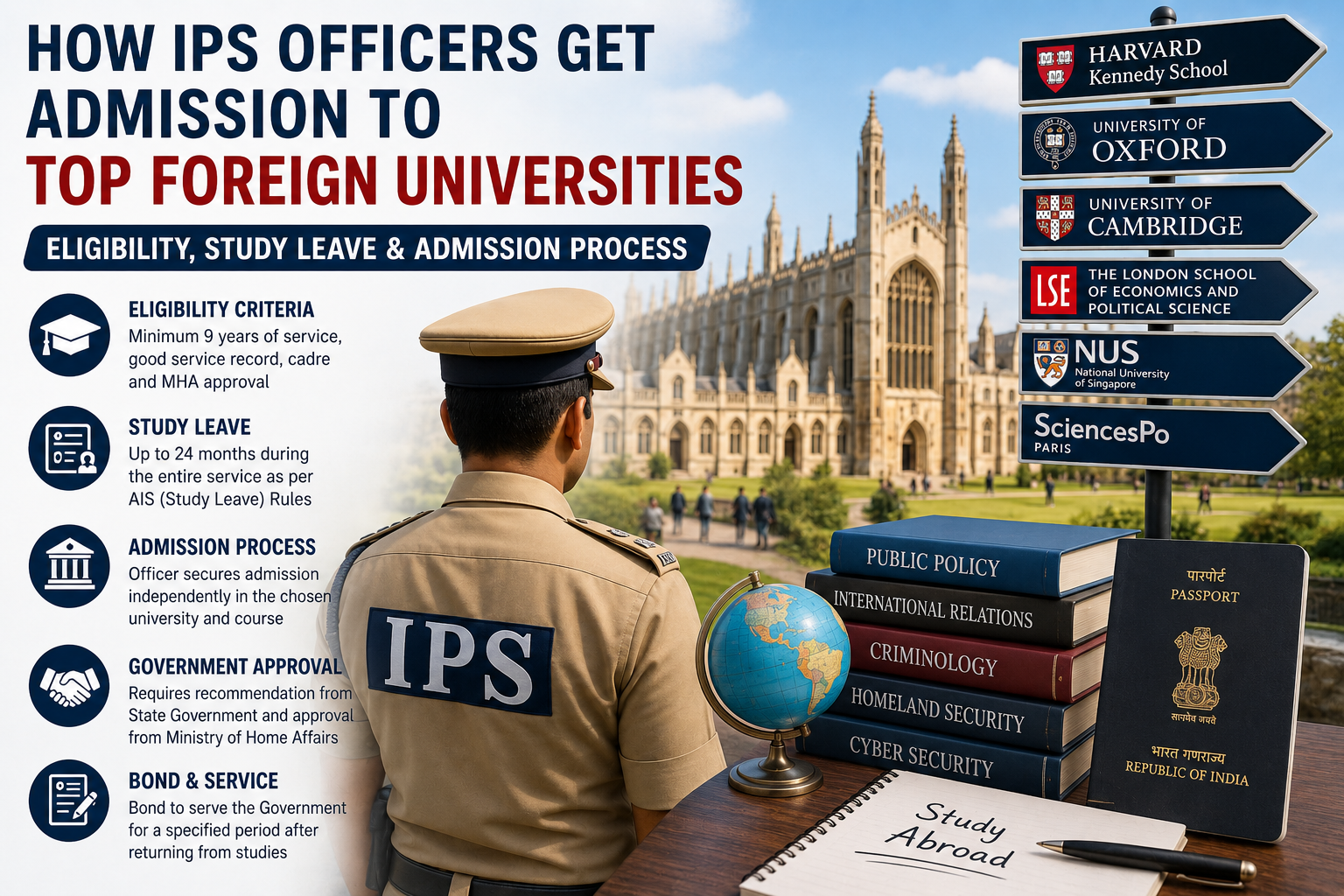
The criteria for IPS officers to pursue higher education at top foreign universities are broadly similar to those for IAS officers, but the controlling authority is the Ministry of Home Affairs (MHA) rather than the Department of Personnel and Training (DoPT). Study leave is governed by the All India Services (Study Leave) Regulations, 1960 and related AIS rules.
Eligibility Criteria
An IPS officer is generally eligible if they:
- Have completed 9 years of service (with certain exceptions in specific cadres).
- Have a consistently good service record.
- Obtain vigilance and disciplinary clearance.
- Receive recommendations from:
- Their State Government/Cadre Controlling Authority.
- The Ministry of Home Affairs (MHA).
- Choose a course that is relevant to policing, internal security, governance, public administration, law, public policy, technology, cyber security, leadership, forensic science, criminology, or national security.
- Demonstrate that the course will benefit policing and public administration in India.
Study Leave
An IPS officer may be granted:
- Up to 24 months of study leave during their career.
- Leave salary and admissible benefits according to AIS rules.
- Permission to pursue full-time study abroad after government approval.
Admission Process
Admission is obtained independently by the officer. The process generally includes:
- Selecting a university and programme.
- Meeting academic eligibility requirements.
- Preparing:
- Academic transcripts
- Statement of Purpose (SOP)
- Resume
- Letters of Recommendation
- Proof of work experience
- Taking standardized tests if required:
- GRE
- GMAT
- IELTS/TOEFL (where applicable)
Only after receiving an admission offer does the officer apply for study leave through official channels.
Government Approval
The proposal is examined by:
- State Government
- Director General of Police (where applicable)
- Ministry of Home Affairs (MHA)
Approval depends on:
- Public interest
- Relevance of the programme
- Availability of officers in the cadre
- Administrative requirements
- Service record and integrity
Bond Requirement
Before proceeding abroad, IPS officers generally execute a bond agreeing to:
- Return to India after completing the course.
- Serve the Government for a prescribed period (commonly five years) after returning.
- Refund government expenditure if the bond conditions are breached.
Popular Courses Chosen by IPS Officers
Unlike IAS officers, IPS officers often pursue specialized programmes such as:
- Public Policy
- Public Administration
- National Security
- Homeland Security
- Cyber Security
- Counter-Terrorism
- Criminal Justice
- Criminology
- Forensic Science
- Artificial Intelligence for Law Enforcement
- Leadership and Strategic Management
Top Foreign Universities Preferred by IPS Officers


Many IPS officers pursue higher education at world-renowned institutions, including:
- Harvard Kennedy School (Public Administration, Leadership)
- Blavatnik School of Government (Public Policy)
- University of Cambridge (Public Policy, Governance)
- Lee Kuan Yew School of Public Policy (Public Administration)
- Sciences Po (Public Affairs)
- King’s College London (War Studies, Security Studies)
- Naval Postgraduate School (Homeland Security, Counter-Terrorism)
- George Washington University (Cyber Security, Security Policy)
Scholarships
IPS officers may finance their studies through:
- Government-sponsored study leave
- University scholarships
- Merit-based fellowships
- International scholarships such as:
- Fulbright Program
- Chevening Scholarships
- Commonwealth Scholarship Commission
Summary
| Criteria | Requirement |
|---|---|
| Minimum service | Generally 9 years |
| Cadre clearance | Mandatory |
| MHA approval | Mandatory |
| Good service record | Required |
| Maximum study leave | 24 months |
| Admission | Officer must secure independently |
| Bond | Mandatory |
| Return to service | Compulsory after completion |
For IPS officers, foreign education is encouraged when it enhances expertise in policing, internal security, cybercrime, intelligence, leadership, and criminal justice, enabling them to contribute more effectively to modern law enforcement and national security upon their return.